Residential electrical wiring wire is almost always insulated copper, sold as a cable with a hot wire, a neutral wire and a bare ground wire inside a plastic jacket. Builders call it NM cable, and many people call it by a brand name, Romex. The thickness is the gauge, and it sets how much current the wire can safely carry. Older houses may have knob and tube or aluminum instead. The knob and tube wiring hub covers the older systems and rewiring.
What does electrical wiring wire mean for your home?
Every circuit in your house is a run of wire between the panel and the outlets, switches and fixtures. The wire has to be thick enough for the breaker on that circuit. A breaker larger than the wire allows is how wiring overheats. Modern homes use grounded copper cable. Older homes may not, and that changes what is safe to plug in.
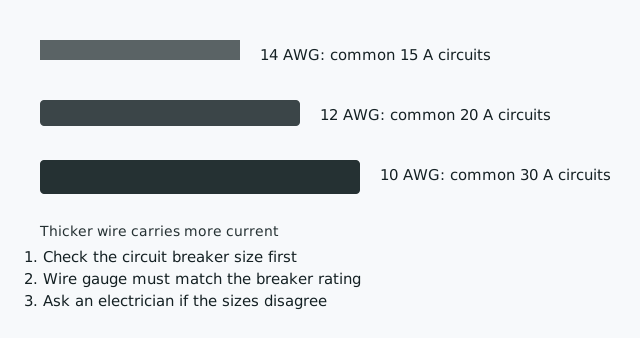
Know the common sizes. Wire gauge uses the American Wire Gauge scale, where a smaller number means a thicker wire. The ampacity limits below are the usual North American residential figures for copper NM cable. The National Electrical Code and the electrician's judgment set the final answer, because temperature, bundling and length change it.
| Gauge (AWG) | Typical breaker | Common use |
|---|---|---|
| 14 | 15 amps | Lighting and some outlets |
| 12 | 20 amps | Outlets, kitchens, garages |
| 10 | 30 amps | Dryers, water heaters, some AC |
| 8 | 40 amps | Ranges, larger loads |
| 6 | 50 amps | Ranges, EV chargers, hot tubs, subpanels |
Many makers color the jacket of two-conductor NM cable as a rough guide to gauge: white for 14, yellow for 12 and orange for 10. There is no standard color for 8 gauge and larger, and the color is not a code requirement. Do not rely on color alone. Read the printing on the jacket.
Inside the cable, the black wire is usually hot, white is neutral, and bare or green is ground. Red is also commonly used for a second hot. Never reuse a white wire as hot without relabeling it properly, which is a job for an electrician.
What types of residential wire and cable are there?
Most houses built after the 1940s use some form of copper cable with a ground. The common types are NM cable inside walls, UF cable for buried or outdoor runs, and individual wires pulled through metal or plastic conduit. Panel feeders and service entrance cables are heavier. Low voltage wire for doorbells, thermostats and networking is separate and carries far less current.
- NM cable (Romex). Plastic jacket, two or three insulated wires plus a bare ground. Used inside dry walls.
- UF cable. Looks similar but is rated for direct burial and damp places.
- Conduit and single wires. Used in garages, outdoors, exposed runs and many remodels.
- Armored cable. Metal-jacketed. Common in older and commercial work.
- Low voltage wire. Thin wire for doorbells and thermostats. Not for lights or outlets.
If you are unsure which type you have, switch the breaker off and have an electrician look. Do not strip or cut into any wire in the wall.
When was knob and tube wiring phased out?
Knob and tube was common from about the 1880s and faded out through the 1930s and 1940s as grounded cable replaced it. Dates vary by region and builder, and some houses were built with it later. It still exists in older houses, and in parts of houses where the owner added modern work around it.
Compare it to modern cable. Knob and tube uses separate single wires on porcelain supports in open air, with no ground. NM cable bundles hot, neutral and ground together in a jacket. The new type is grounded, tougher and meant to sit in an insulated wall. The older type was not, and insulation around it traps heat. That is why replacement from knob and tube to modern cable is a common project, and why it is priced in rewire house cost. The explainer what is knob and tube wiring goes into more detail on the risks.
What is aluminum wiring, and is it bad?
Aluminum branch-circuit wiring was used in many American homes from about the 1960s to the mid-1970s, during a copper shortage. It is not banned, but older solid aluminum wire can expand, loosen and overheat at connections, and the Consumer Product Safety Commission has issued guidance on it for decades. Homes built before 1965 are unlikely to have it, according to that guidance.
How to check: look at the jacket in the panel or an accessible junction box. Aluminum cable is usually marked "AL" or "ALUMINUM", while copper cable shows copper-colored conductors. Switches and outlets made for aluminum may be marked CO/ALR. Do not remove device covers on live circuits to check. Ask an electrician.
The CPSC describes repair options. Special crimp or set-screw connectors installed by a qualified electrician can make permanent connections at each point. Twist-on connectors are not recommended as a permanent repair. CO/ALR outlets and switches are not considered a permanent repair either. Rewiring in copper is the most complete fix and usually the costliest. Your electrician should explain which option they would use and why. Insurance companies sometimes ask about aluminum wiring too, so ask yours.
How do electricians rewire a house?
They inspect and map the circuits, pull a permit, run new cable through attics, crawl spaces and walls, connect it to a panel that can carry the load, then remove or disable the old wire and call for inspection. Access sets the effort. Open attics and crawl spaces make it faster. Finished walls and plaster make it slower and lead to patching afterward.
Rewiring does not have to cover the whole house. An electrician can replace the worst circuits, add ground fault or arc fault protection, and leave sound copper cable alone. For the full process, see wiring knob and tube replacing. Whether it needs walls opened is covered there too.
Who can rewire a house in California, and is a permit required?
California law requires electrical work for others to be done by a contractor holding a C-10 electrical license from the Contractors State License Board. The board says a license is needed for work valued at $1,000 or more, or whenever a building permit is required. San Joaquin County states that permits are required to install, alter, replace or repair electrical services and systems, and the City of Stockton runs its own permit process.
Homeowners may be able to pull permits for their own house as owner-builders, with the work inspected. That is a decision to make carefully. Wire sizing, breaker matching and ground connections are the usual causes of failed inspections and fires.
What does it cost, and are there grants?
National price guides put whole-house rewiring at roughly $4 to $10 per square foot, and knob and tube replacement at about $8 to $20. Ranges are on the rewire house cost page. No reliable Stockton program that pays for knob and tube removal turned up in research for this guide, so ask the City of Stockton and your insurer whether any help exists before you assume none does.
Get quotes in writing from two or three electricians, and compare scope line by line. You can ask for quotes here, and read how it works first if you want to know the steps. An electrician in Stockton can look at the actual wire in your house, which no guide can do.
Questions people ask
Is Romex better than knob and tube wiring?
For most uses, yes. NM cable (Romex) has a built-in ground wire, a protective jacket and a design meant for insulated walls. Knob and tube has no ground, relies on open air to stay cool and ages badly. That does not make every old circuit dangerous, but modern cable is the better standard for any house you are changing.
Is aluminum wiring bad in a house?
Not automatically. Older solid aluminum branch wiring can loosen and overheat at connections, which is why the Consumer Product Safety Commission warns about it. Properly repaired connections reduce the risk. An electrician should inspect it, advise on repairs and tell you what insurers might ask. Do not ignore warm outlets or a burning smell.
How do I tell what gauge my wire is?
Read the printing on the cable jacket, which lists the gauge, such as 14/2 or 12/3. The first number is the gauge and the second the number of insulated wires. Do not open live boxes yourself. If the jacket is hidden or worn, an electrician can identify the wire safely.
Can I use bigger breakers on old wire?
No. The breaker is there to protect the wire. A larger breaker lets more current flow before it trips, which can overheat the wire inside the wall. If a breaker keeps tripping, that is a sign to find the cause, not to upsize. See breaker keeps tripping.
Does home insurance cover old wiring?
It depends on the insurer. As widely reported, some companies restrict coverage for homes with knob and tube or aluminum wiring, or ask for an electrician's report. Others do not. Call your insurer or agent and ask what they require in writing.
Sources used
- Electrical wiring in North America, Wikipedia
- Knob-and-tube wiring, Wikipedia
- Aluminium building wiring, Wikipedia
- CPSC Publication 516, Repairing Aluminum Wiring
- California Department of General Services, Building Standards Commission, codes
- NEMA Technical Bulletin 94, NM-B cable jacket color coding
- EE Power, NEC basics, sizing and protecting branch circuit conductors
Last changed