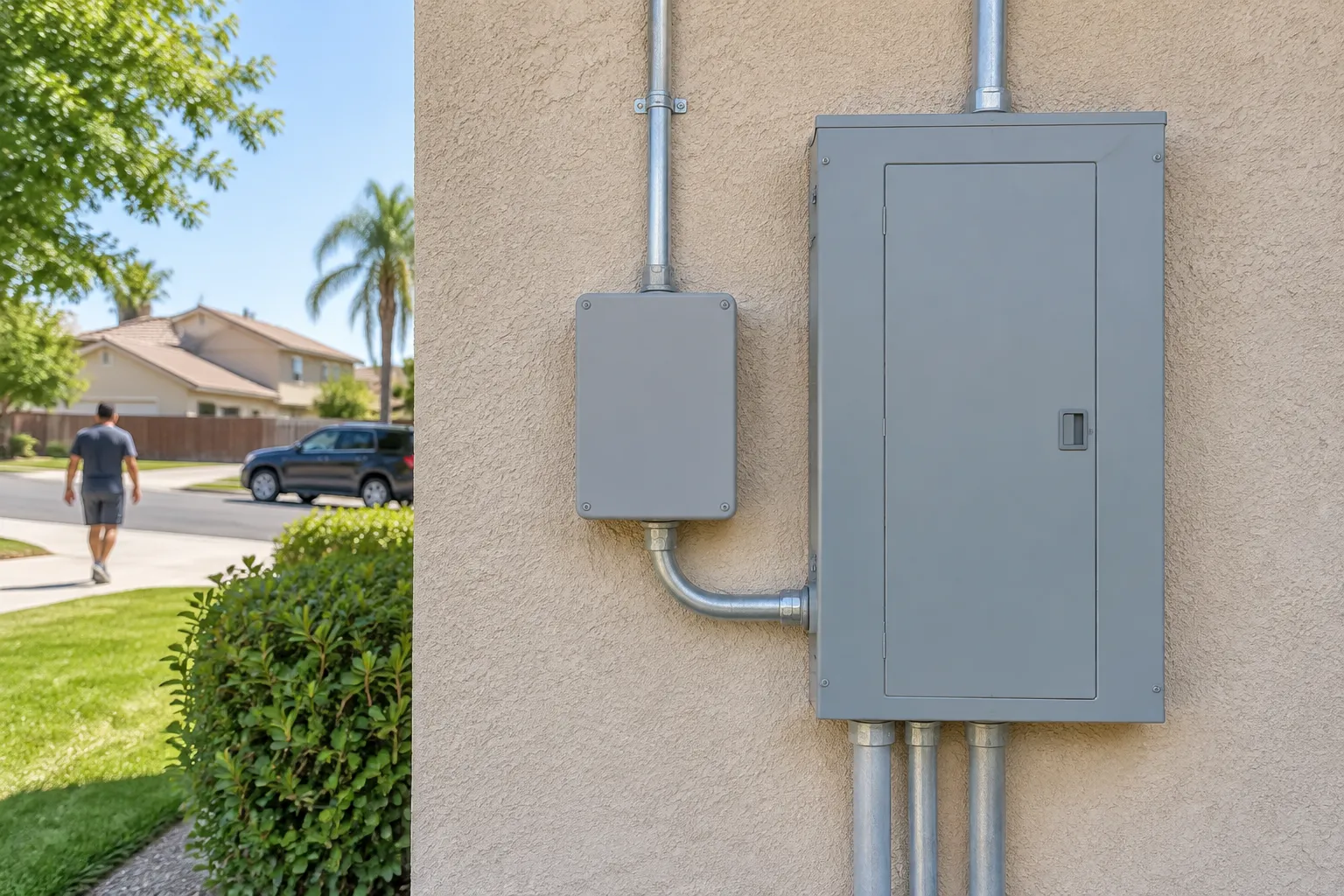
Installing a whole house surge protector means mounting a device at or beside your main electrical panel and wiring it to a breaker and to ground. An electrician usually finishes the job in one to two hours, after turning off power to the panel. In California, the work is done for others by a contractor with the right license, and it normally needs a permit. This page is the how-to side of the job. For what the device is and whether you need one, see the whole-house surge protector overview.
How is a whole house surge protector installed?
An electrician turns off the main breaker, opens the panel, and connects the surge device to a dedicated double-pole breaker, usually in a spare slot. Short wires run from the device to the breaker and to the neutral and ground bars. Wire length matters, so the device is placed as close to the panel as possible. Then power is restored and the status light is checked.
Two mounting styles are common. Some devices are built to sit inside the panel and plug into a breaker slot. Others are small boxes mounted on the outside of the panel and wired in through a knockout, which is a punch-out hole in the panel box. The manufacturer's installation sheet sets the breaker size, the wire gauge and the maximum wire length. The electrician follows it exactly, because a long or looped wire reduces the protection.
The main lugs and the utility side of the meter stay live even with the main breaker off. That is the main reason this is not a casual job. If you see a burnt smell, scorching or sparks at the panel, leave the area and call 911. If you suspect a problem on the utility side of your meter, call PG&E.
What are Type 1 and Type 2 surge protectors?
Type 1 devices may be connected on the utility side of the main service disconnect. Type 2 devices are connected on the load side, at or after the main breaker, which is where most home installations go. National Electrical Code section 230.67 calls for a Type 1 or Type 2 device on dwelling services, and it generally allows the device to be part of the service equipment or placed right next to it.
In most homes the electrician installs a Type 2 device, because it connects inside or beside the main panel. A Type 1 may be chosen when the work is at the service entrance, and the electrician decides based on the equipment. Plug-in strips are point-of-use devices, listed as Type 3, and they are not a substitute for the panel device.
You do not need to pick the type yourself. Ask the electrician which one they propose, what the voltage protection rating is, and whether the unit is made for your panel or approved to work with it.
Who can install a whole house surge protector in California?
A contractor holding the C-10 electrical license from the Contractors State License Board should do it. The Contractors State License Board says a license is required for work that needs a building permit, uses employees, or is valued at $1,000 or more in labor and materials. Panel work usually needs a permit, which puts this job under the rule even though the price is often below $1,000.
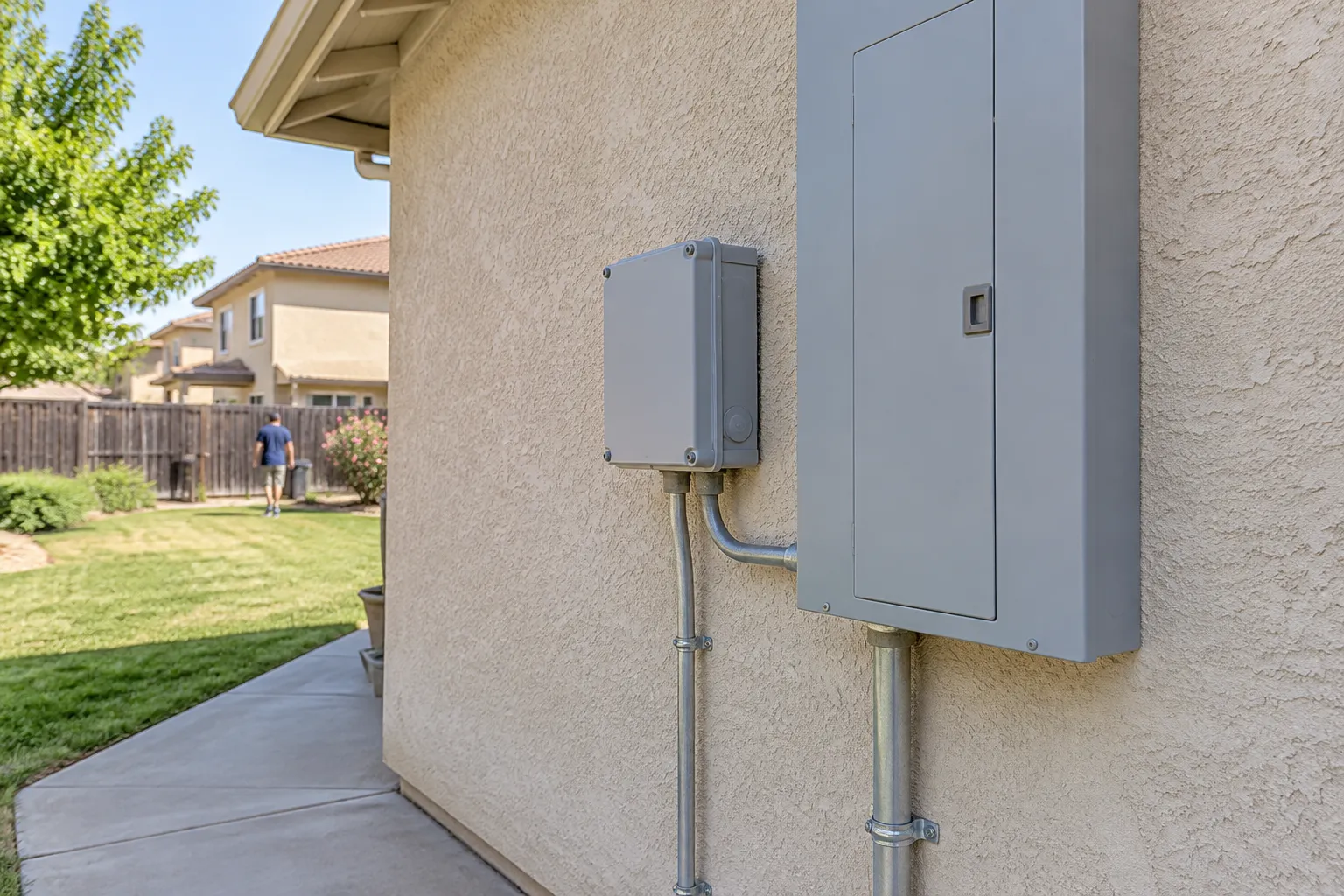
The state contractor board describes the C-10 electrical classification as work that places, installs or connects electrical wires, fixtures, appliances and apparatus that use or transmit electrical energy. A device wired into your service panel fits that description. You can check any contractor's license on the CSLB website before you hire. Read our guide on how to choose an electrician for a longer checklist.
Can I install a whole house surge protector myself?
California lets owners do some work on their own homes under an owner-builder exemption, but the work generally needs a permit and an inspection, and you take on the risk. Working inside a live panel can cause serious injury. I do not recommend this as a do-it-yourself project, and I cannot verify local owner-builder terms for your address.
If you are an experienced owner and want to proceed, start with the building department. San Joaquin County states that a permit is required for installation, alteration, replacement and repair of electrical services and systems. The City of Stockton Community Development building division covers addresses within the city. Ask what they require from an owner, and whether they inspect surge devices.
Even skilled owners can get it wrong in small ways, like using a breaker of the wrong size or leaving a long loop of wire that weakens the protection. The cost of an electrician is often small compared to the risk.
Do I need a permit to install a whole house surge protector?
Often yes. A device wired into the service panel is an alteration of the electrical system, and California building departments require permits for that kind of work. Some jurisdictions may treat a small device as minor, so the answer depends on your local rules. The electrician usually knows and pulls the permit for you.
Confirm with the building division that covers your address. If the surge protector is part of a larger panel upgrade, one permit often covers all of it. A permit leads to an inspection, and an inspection is a record that the work met the code. That record helps if you sell the home or file an insurance claim after a surge. Our page on residential electrical panel upgrades explains the bigger job.
What affects the price of installing a whole house surge protector?
National price guides put the installed cost at roughly $200 to $800. The device often runs $60 to $300, and labor another $140 to $300. The price rises if the panel is crowded, has no open breaker space, needs a new breaker, or has older wiring that has to be fixed first.
The main factors are the type and rating of the device, how easy it is to reach the panel, whether the panel has a free double-pole slot, and the local permit fee. A simple install on a modern panel sits near the low end. A job that also needs a panel repair or a subpanel moves toward the high end. Our price guide for whole house surge protectors lists the figures in a table.
What should I check after the installation?
Look at the status indicator. A green or lit light usually means the protection is active, and the manual explains what other colors mean. Take a photo of the device and the label. Keep the permit, the inspection record and the product documentation in one place, since warranty and connected-equipment terms often require proof.
Check the light every few months and after any major storm or power event. A surge protector wears out as it absorbs surges, so its life depends on how often surges hit. If the light shows a fault or goes dark, call a local electrician to replace the unit.
If your breakers trip often, a surge protector will not solve it. Read about a circuit breaker that keeps tripping and ask an electrician to inspect the panel.
Questions people ask
How long does it take to install a whole house surge protector?
A simple install is often one to two hours. The electrician turns off power to the home for part of that time. A crowded panel, a needed repair or a permit inspection can add time. Ask for the time and the outage length when you request the quote.
What should I ask before I hire someone to install a whole house surge protector?
Ask for their California contractor license number and verify it with CSLB. Ask which device and type they propose, the voltage protection rating, who pulls the permit and what the total price covers. Ask whether panel work is needed and what it would add.
Do I need to be home for the installation?
Someone needs to be home to let the electrician in, show the panel and approve the work. Power goes off for a short time, so plan around computers and anything that must not lose power. Ask how long the outage will be.
Does the brand of my panel matter?
Yes. The surge device should be made for your panel or approved to work with it, and the installation sheet sets the details. Mixing parts can break the panel's listing. Ask the electrician to confirm the match.
Will a surge protector stop a lightning strike?
It reduces the risk from surges near the home, but it cannot promise protection from a direct strike. If lightning damages your home, leave and call 911 if there is fire, then contact PG&E for any power line problem.
For help finding local electricians, start from a local electrician or the price request form.
Sources used
- Surge protection requirements under the 2023 NEC, section 230.67 (code-training summary)
- UL 1449 surge protective device types, summary
- CSLB, Hire a Contractor
- CSLB, What Kind of Contractor Do I Need
- CSLB, C-10 Electrical Contractor classification
- San Joaquin County Community Development, residential electrical permits
- Published 2025 and 2026 whole-house surge protector price guides
Last changed