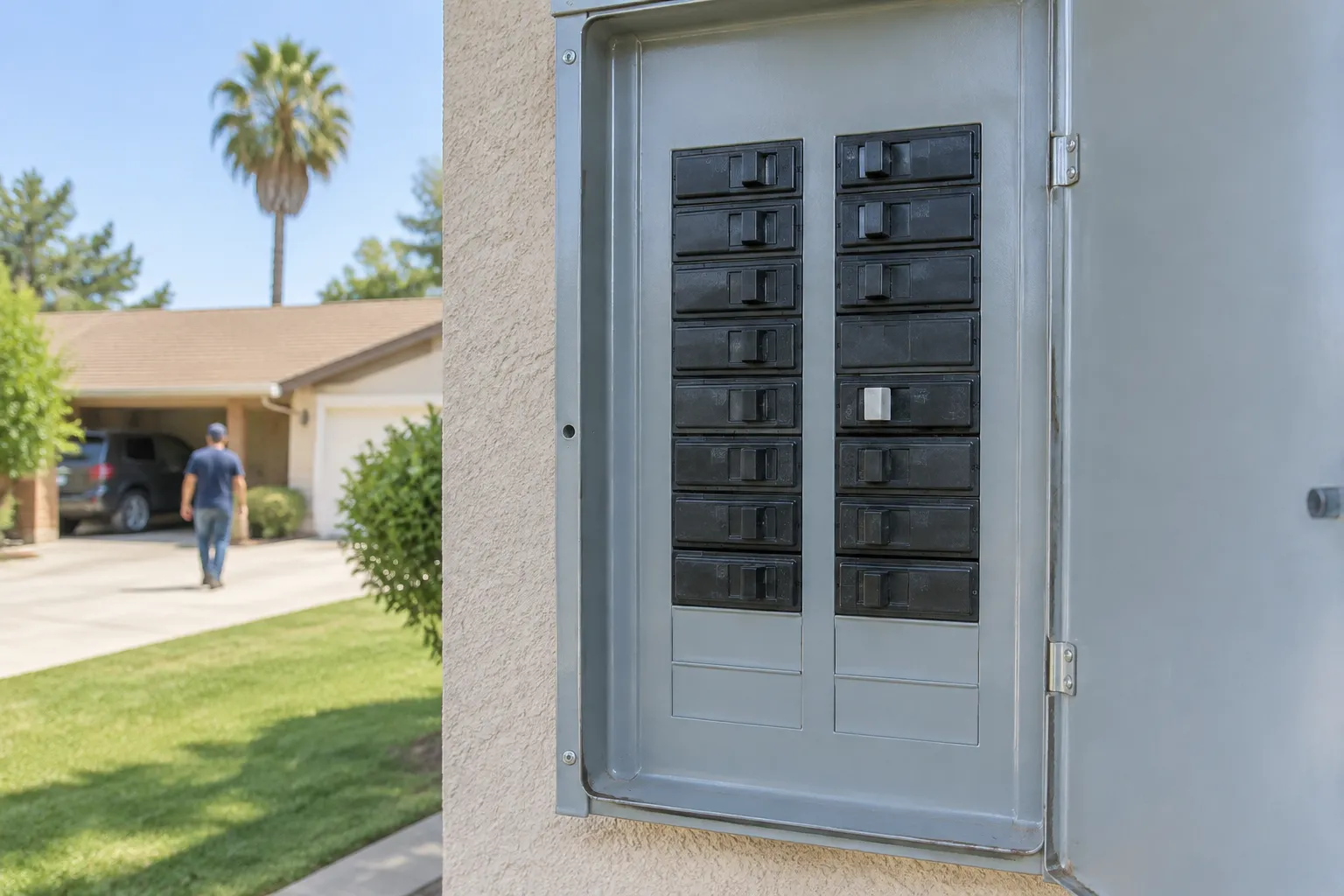
A circuit breaker that keeps tripping is shutting off power because something on that circuit is drawing too much current, leaking current or arcing. To fix it, unplug everything on the circuit, reset the breaker once, then plug items back in one at a time until it trips. The item that trips it is the culprit. If it trips with nothing plugged in, the wiring or the breaker needs an electrician.
This page covers the four causes, how to find the one you have, what to do about a main breaker, and when a tripping breaker is an emergency. Smaller questions have their own pages: why a breaker keeps tripping, AFCI versus GFCI, air conditioners that trip breakers and what an electrician charges to fix a breaker.
Why does a circuit breaker trip in the first place?
A breaker trips for one of four reasons: an overloaded circuit, a short circuit, a ground fault or an arc fault. Each one means current is going where it should not, or too much of it is flowing. The breaker opens the circuit to stop wires from overheating. A trip is a warning, not a defect, so resetting it again and again is the wrong response.
Here is how the four differ:
| Cause | What is happening | Typical sign |
|---|---|---|
| Overload | Too many appliances draw more current than the wire and breaker are rated for | Trips after a few minutes of use, often when a heater, hair dryer or microwave runs |
| Short circuit | A hot wire touches a neutral wire or another hot wire | Trips the instant you reset it, sometimes with a pop or a burn smell |
| Ground fault | Current leaks to ground, often through water or damaged insulation | A GFCI breaker or outlet trips, often near sinks, outdoors or in a garage |
| Arc fault | Damaged or loose wiring sparks inside a wall or cord | An AFCI breaker trips, sometimes at random, sometimes when a particular device runs |
Overload is by far the most common cause in older homes with few circuits. Short circuits and arc faults point to damaged wiring or a faulty device, and they carry a real fire risk.
My circuit breaker won't reset even though there's nothing plugged in. What could be the problem?
If a breaker will not reset with nothing plugged in, the fault is in the circuit wiring, a hard-wired device such as a light fixture or fan, or the breaker itself. Do not keep forcing it. Push the handle fully to off first, then to on. If it trips again, leave it off and have an electrician trace the circuit.
Things worth checking before you call:
- Look for hard-wired items on that circuit: ceiling fans, bath fans, garage door openers, smoke alarms and under-cabinet lights stay connected even when you unplug everything.
- Check for a GFCI outlet on the same circuit that has tripped upstream. Press its reset button.
- Check the handle position. A tripped handle often sits in the middle, and it must go fully to off before it will go back on.
- Notice any warmth, buzzing or burn smell at the breaker. If you notice any, stop and read the emergency section below.
If none of this explains it, the cause is likely a short in the wall wiring, a failed device or a worn breaker. All three need an electrician with a C-10 license, which California requires for electrical work done for others.
What will cause a breaker to trip again after it is reset?
A breaker trips again after a reset because the cause is still there. The most common reasons are an overloaded circuit that is still carrying the same load, a failing appliance, moisture in an outlet or fixture, or damaged wiring. A breaker that holds for hours then trips usually points to heat building up under load.
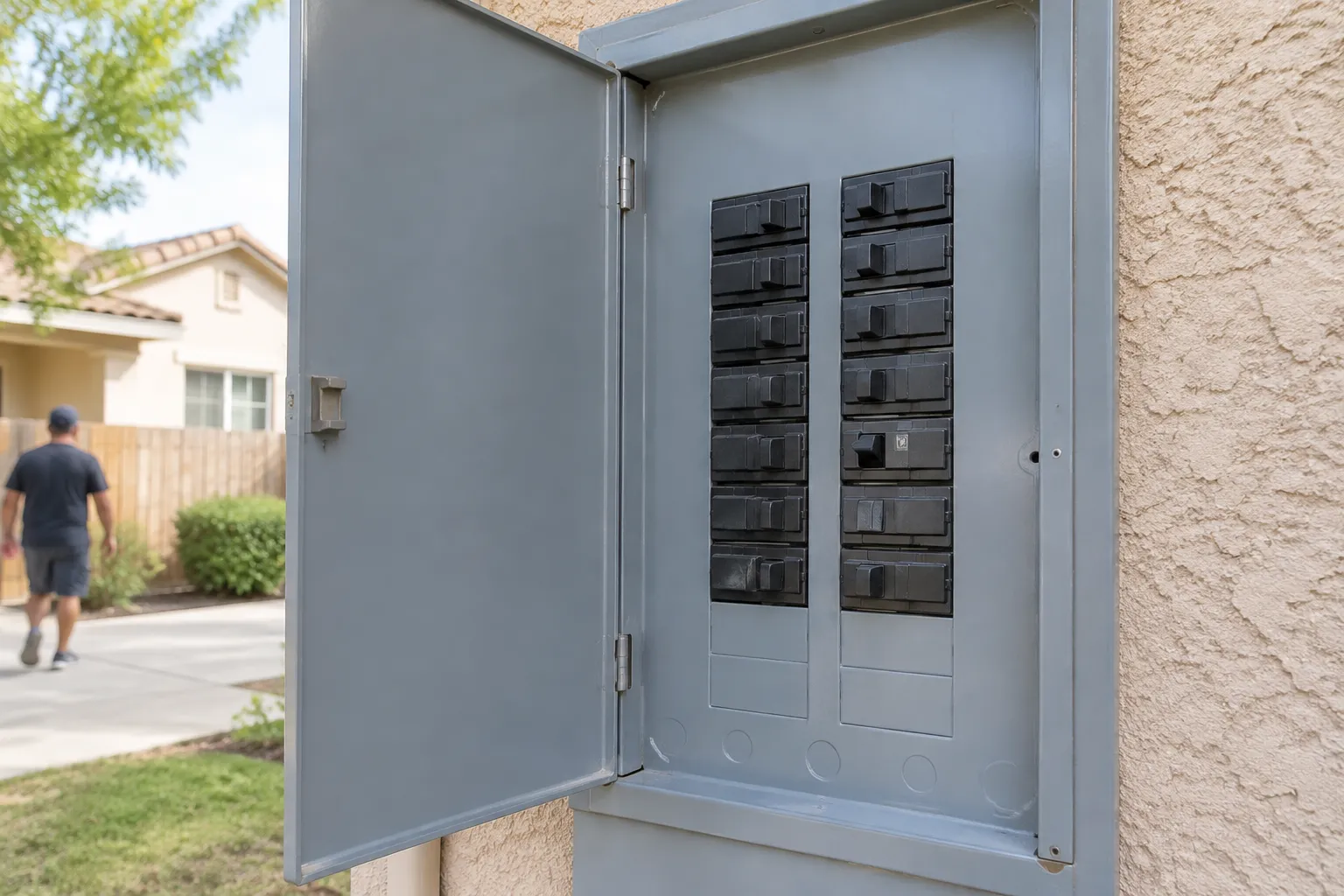
Common repeat offenders:
- Space heaters, microwaves, toasters and hair dryers share a circuit with other loads and pull a lot of current. Details on these are on the page about why a breaker keeps tripping.
- Furnaces and heaters can trip a breaker when a blower motor is failing or a heating element is shorted. A furnace that trips its breaker should be checked by an HVAC technician or an electrician, not reset repeatedly.
- Treadmills and other motor-driven equipment draw a surge on start and can trip a breaker shared with other loads. Putting the treadmill on its own circuit is a common fix, and that is electrician work.
- Random trips with nothing obvious running often mean a loose connection, a moisture problem or an AFCI picking up a faulty cord. Write down what was running each time. A pattern helps the electrician.
What can I do if the main switch keeps tripping?
If the main breaker keeps tripping, turn off every branch breaker, reset the main, then switch the branches back on one at a time. A main that trips only after a certain branch comes on points to that circuit. A main that trips with every branch off needs an electrician right away, because the fault may be in the panel or service.
Main breakers are rated for the whole house, so a trip usually means the total load is too high or there is a serious fault. Do not open the panel cover. The service conductors that feed the main breaker stay live even when the main is off, and the panel is not a place for a homeowner to work. If the main will not reset, the panel is hot, or you see scorch marks, treat it as urgent. A local electrician can assess whether the main breaker is worn or whether the panel needs an upgrade.
How do I fix a breaker that keeps tripping?
Work from least risky to most. Unplug everything on the circuit, reset the breaker, then add items back one at a time and note which one trips it. If one device trips it every time, that device is faulty. If nothing trips it until several are on, the circuit is overloaded and the load needs to be spread out.
Step by step:
- Find the circuit. The panel label should name the room. If labels are missing, switch breakers off one at a time to map them.
- Unplug everything on that circuit, and turn off wall switches for hard-wired items.
- Reset once. Push the handle to full off, then on.
- If it holds, add loads back one at a time with a few minutes between each.
- If one device trips it, stop using that device. Test it on a different circuit. If it trips there too, repair or replace it.
- If it trips with all loads removed, stop. Call an electrician.
You can do steps 1 to 5 yourself. Stop at any point where the breaker trips with nothing connected, where you see damage, or where you are unsure. California law requires electrical work for others to be done by a contractor holding a C-10 electrical license from the Contractors State License Board, and a local electrician can find the fault and quote the repair. Getting a clear picture first also helps you choose one, as covered in how to choose an electrician.
When is the breaker itself bad?
A breaker can wear out. Signs include a handle that feels loose, a breaker that trips well below its rating, a breaker that will not stay on with no load, heat or discoloration at the breaker, or a buzzing sound. Breakers are meant to trip, but a breaker that trips for no clear reason, or that feels hot, should be checked by an electrician.
Do not swap a breaker yourself. Breakers must match the panel brand and type, and the connection sits next to live parts. An electrician tests the circuit first, because replacing a breaker that tripped for a real reason hides the problem. For what a replacement usually costs, see the breaker repair cost guide.
Why is my electrical panel hot?
A panel that is warm after heavy use can be normal, but one that is too hot to keep your hand on, smells like burning, hums loudly or shows scorch marks is not. Heat usually comes from a loose connection, an overloaded breaker or a failing main. Turn off what you can safely, stay clear of the panel and call an electrician. For smoke, sparks or a burning smell, call 911.
Do not open the panel to look. Do not spray water on it. A hot panel is a sign of resistance heating at a connection, and that is one of the ways electrical fires start. If you also notice flickering lights across the house, a loose neutral or main connection may be involved, and the page on flickering lights explains what else can cause it.
When should you call an electrician, 911 or PG&E?
Call 911 for smoke, fire, sparking, a burning smell from the panel or an outlet, or anyone shocked. Call PG&E if the problem may be on the utility side: downed lines, a damaged meter or service drop, or a power outage that affects only your home. Call an electrician in Stockton for repeated trips, a breaker that will not reset, or a hot panel with no smoke.
Use this as a guide:
- 911: visible flames, smoke, sparks from the panel, or someone hurt by electric shock.
- PG&E: wires down, a damaged meter or the line from the pole to your house, or a gas smell. Stay back from downed lines and treat them as live.
- Local electrician, same day if possible: a main that will not reset, a hot panel, a breaker that trips with nothing plugged in. See the guides on same-day electrician help and electrician help for a power outage.
- Local electrician, scheduled visit: repeat overload trips, AFCI or GFCI trips with no clear cause, or a request to add circuits. Price expectations are in the emergency electrician cost guide.
The home electrical repair guide covers other common faults, and the outlet not working page covers a dead outlet when the breaker looks fine.
What does it cost to fix a tripping breaker?
National price guides put a single breaker replacement at roughly $150 to $400 including parts and labor, and $200 to $500 for AFCI or GFCI types. Finding a wiring fault, replacing a failed device or upgrading a panel costs more. Your electrician's own quote overrides any guide.
What moves the price: breaker type (standard, AFCI, GFCI or dual-function), panel brand and age, how hard the fault is to trace, and whether a permit is needed. See the full table on the breaker repair cost page and the electrician cost in Stockton overview.
A tripping breaker is sometimes one symptom of a wider issue, such as a crowded panel or surge damage. Ask about whole-house surge protection if trips follow storms or utility blips.
Questions people ask
How long does fixing a tripping breaker take?
A simple overload fix, such as moving a heater to another circuit, takes minutes. Replacing a single breaker usually takes under an hour once the electrician has tested the circuit. Tracing a short or arc fault in the wiring can take a few hours, and rewiring a run can take longer. The electrician can give a time estimate once they see the panel.
What should I ask before I hire someone to fix a tripping breaker?
Ask for the C-10 electrical license number and check it on the CSLB website. Ask whether the quote covers finding the cause or only swapping the breaker, whether a permit is needed, what happens if a fault is found in the wall, and whether parts and labor are separate. Ask what happens if the breaker trips again afterward.
Do I need to be home while the electrician works?
Usually you need to be there at the start so the electrician can reach the panel and see the problem, and at the end to review the work. Some jobs need power off for a while, so plan around freezers, medical devices and work-from-home needs. Tell the electrician about any equipment that cannot lose power.
Is it safe to keep resetting a breaker that keeps tripping?
No. A breaker that trips again and again is reporting a fault. One reset is reasonable to test whether it was a one-time overload. Repeated resets can stress the breaker and, if the fault is a short or arc, put heat into the wiring. Stop after one or two trips and find the cause.
Read on
- AFCI vs GFCI
AFCI vs GFCI explained: a GFCI protects people from shock, an AFCI protects wiring from fire.
- AC tripping the breaker
Air conditioner keeps tripping the breaker?
- Why breakers trip
Why a breaker keeps tripping, what is safe to check yourself, and when a breaker that will not stay on needs a local electrician in…
- Breaker repair cost
What an electrician charges to fix or replace a breaker in Stockton: typical price ranges by job, what pushes the price up and what to ask…
Sources used
- CSLB C-10 Electrical Contractor classification
- Safe Electricity, Ground Fault Circuit Interrupters
- Published 2025 and 2026 US price guides for breaker replacement and electrician rates
Last changed