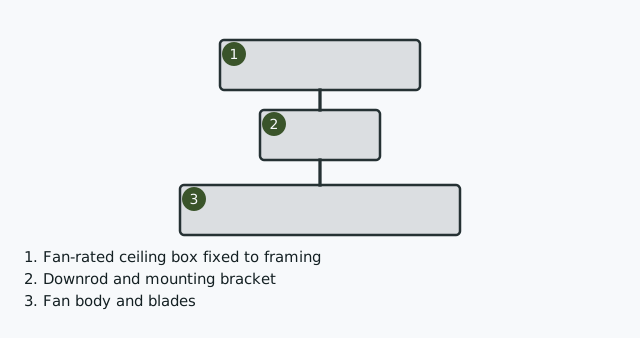
Wiring a ceiling fan means connecting four wires in a standard install: the fan's black motor wire to the supply hot wire, its blue wire to the light, the white to the neutral and the green or bare wire to the ground. The wires only carry power. The weight of the fan must be carried by a box and bracket that are made for a fan. Always read the manual for your model, since colors vary. This guide is part of our section on lighting, fans and fixtures.
What wires does a ceiling fan have and where do they connect?
A typical fan has a black wire for the motor, a blue wire for the light kit, a white neutral wire and a green or bare ground. At the ceiling you usually find a black supply wire, a white neutral and a bare or green ground. Black joins black, blue joins black for a combined switch, white joins white and grounds join together.
Colors can differ, so follow the manual that came with the fan. A common layout:
| Fan wire | Connects to | What it does |
|---|---|---|
| Black | Supply hot (black) | Powers the motor |
| Blue | Supply hot, or a separate switched wire | Powers the light kit |
| White | Neutral (white) | Completes the circuit |
| Green or bare | Ground | Safety ground |
Join wires with the connectors the maker supplies and tuck them into the box without strain. Always turn off the breaker first and confirm with a voltage tester that the wires are dead. A light switch being off is not enough.
What does the red wire from the ceiling mean?
A red wire in the ceiling box usually means the home has two switched supplies, one for the fan and one for the light, so each can be controlled by its own wall switch. The red wire normally goes to the fan's blue light wire, and the black supply goes to the motor. If a red wire reaches the box but the fan has none, this is the usual case.
Check the fan's manual and your switches. If there is only one switch, you can join both hots together so one switch runs both, though you lose separate control. If the red wire is not connected to anything, the light kit may not work. If you cannot tell which wire is which, stop. Guessing in an attic is how people get shocked.
If the fan has a remote or a wall control, the receiver in the canopy takes the place of one of the separate switches, and the manual shows where each wire goes.
Does the box need to be rated for a ceiling fan?
Yes. A fan moves and vibrates, so the box must be made for it. The National Electrical Code requires a box used as the only support for a ceiling fan to be listed and marked for that use, a box for a fan over 35 pounds must also be marked with the weight it can carry, and fans heavier than 70 pounds must be supported independently of the box. Ordinary light boxes are not made for this load.
How to tell what you have:
- Look for a marking. A fan-rated box says so on the box or in the packaging, often with a weight limit.
- Look at how it is fixed. A fan-rated box is fixed to a joist or a brace, and a plain plastic or thin metal box held by two small screws is not.
- Check from above. From the attic you can see whether the box is on a joist or a brace.
If it is not rated, you have three choices. Fit a fan-rated box in place of the old one. Fit an adjustable brace that spans between two joists. Or call an electrician to do it. Which option is right depends on access and the ceiling, and the code edition adopted in California can change the exact wording, so ask your local building department if you are unsure.
How do I support a ceiling fan from a ceiling with no joist?
You use an adjustable brace that spans two joists through a hole in the ceiling, or you open the ceiling and fasten the box to new framing. A plain light box in drywall cannot carry a fan. Retrofit braces expand against the joists so you can fit them from below without removing the ceiling.
The brace holds a rated box in the center of the span. Tighten it until the brace is firm, then fit the fan's mounting bracket to the box with the bolts the manual calls for. Do not substitute a screw that is shorter or thinner. If the room above is a living space and you cannot reach the joists, an electrician can open the ceiling to fit proper support. It is one of the reasons a fan on a new location costs more.
How do flush mount, low profile and outdoor fans differ?
Flush mount (low profile) fans sit close to the ceiling, with no downrod, for rooms with low ceilings, and they hang from the same fan-rated box as any other fan. Outdoor fans need a damp or wet rating on the label and must be matched to the place: a covered porch needs damp rated, and an exposed location needs wet rated.
Check the fan's label and the manual. The junction box adapter, sold for fans with a bracket that does not fit the existing box, must be one the fan maker lists for the model. Model specific instructions, such as the ones that come with a particular brand and line of fans, give the right bolt sizes and canopy fit. Outdoor fans also need weatherproof boxes and connections, so the wiring is more involved than indoors. If it ends at a new outdoor location, that is the electrician's job.
A fan rated for a wet place is not the same as a fan rated for a damp place. Using the wrong one can shorten its life and cause a shock risk.
Is DIY ceiling fan wiring safe, and what does the law say?
Replacing a fan with a fan on a fan-rated box is a job many homeowners can do carefully on their own home. Adding a fan where there was no wiring, changing the box, or working in a location you cannot see is where to hire. California requires a C-10 electrical contractor for electrical work done for others when labor and materials reach $1,000, or when a permit or hired workers are involved.
The Contractors State License Board states that an unlicensed person may complete projects under $1,000 only if they hire no workers and no permit is needed. A fan on new wiring usually needs a permit, and then a license is required for anyone you hire. If you do the work on your own home, check with the City of Stockton Building Division on permits. Whether work needs a permit and an inspection is a local rule.
Stop and call a local electrician if you find any of these:
- Wires with cracked or cloth-covered insulation.
- Aluminum wire, or only two wires at the box.
- Scorch marks, a burning smell or a box that is warm.
- A box that moves or a ceiling that sags.
- Wires you cannot identify with a tester.
If your house has older wiring, see what knob and tube wiring is. To compare what hiring costs, see the ceiling fan installation cost ranges. To learn who to ask, read choosing an electrician for ceiling fan installation.
Questions people ask
How long does ceiling fan wiring take?
A swap on a good fan-rated box often takes one to two hours, including assembly. A new location with new cable and a new box can take half a day or more. Plan extra time for patching if the ceiling is opened.
What should I ask before I hire someone for ceiling fan wiring?
Ask who holds the C-10 electrical license and whether the quote covers the fan-rated box or brace, any new cable, the switch and patching. Ask whether a permit is needed and who pulls it. Get the quote in writing, with a list of anything left out, and compare at least two.
Do I need to be home for ceiling fan wiring?
Yes, usually. The electrician needs access to the room, the panel and sometimes the attic, and you will want to approve the fan location. You should also see the fan tested at the end, at each speed and with the light on, before the job is finished.
Can I use a regular light fixture box for a ceiling fan?
Not unless it is marked for fan support. A plain light box is made to hold a light fixture, not a fan that moves. If the box is not marked, replace it with a fan-rated box or fit a brace. If you are not sure, a local electrician can check it quickly.
What if my fan wobbles after wiring?
Wobble is usually from loose blade screws, a bent blade or an unbalanced set, not the wiring. Switch the fan off and check the screws and the downrod. If the box itself moves, turn the fan off and do not run it until the support is fixed.
For lighting and fan quotes, ask a local electrician to look at your ceiling.
Sources used
Last changed