A GFCI outlet watches the current going out on the hot wire and the current coming back on the neutral. If they differ by as little as 4 or 5 milliamps, current is leaking somewhere it should not, perhaps through a person, and the device shuts the circuit off in less than a tenth of a second. California requires this protection in the wet and damp parts of a home, through the California Electrical Code, which adopts the National Electrical Code with amendments. Understanding the device makes a quote easier to judge. This article, part of the outlets, switches and GFCI guide, covers how the protection works and where it is required. For step-by-step installation, see the GFCI installation guide.
How does a GFCI actually protect you?
A GFCI compares the current leaving on the hot wire with the current returning on the neutral. They should match. When some current escapes by another path, such as through your body to a wet floor, the device senses the gap and cuts power quickly enough to prevent a serious shock. It protects people, not just equipment.
Safe Electricity describes the trip threshold as a difference of 4 or 5 milliamps and the response time as less than one-tenth of a second. That is far faster and far more sensitive than a breaker, which trips only when current climbs well above the circuit's rating. A breaker protects wire from overheating. A GFCI protects people from shock.
That difference explains why a hair dryer dropped in a sink can trip a GFCI and not the breaker, and why a circuit can be safe for the wire and still dangerous to touch.
Two devices people mix up:
- GFCI. Guards against shock from current leaking to ground.
- AFCI. Guards against fire from arcing in damaged wire or loose connections.
The AFCI versus GFCI page sets the two side by side.
How does one GFCI protect other outlets?
A GFCI has line terminals that take the incoming power and load terminals that pass protected power downstream. Any outlet wired to the load side is covered. That is why one GFCI in a bathroom can protect outlets in the hallway or garage, and why a dead outlet can trace back to a tripped GFCI elsewhere.
There are three common arrangements:
- A single GFCI outlet protecting only itself. The load terminals are unused.
- A GFCI at the start of a run protecting every outlet after it. The cheapest way to cover a room or a line of outlets.
- A GFCI breaker in the panel protecting a whole circuit. Every outlet on that circuit is covered, and the reset is at the panel.
Outlets protected from upstream are often ordinary receptacles, and some are marked "GFCI protected" with a sticker. If a downstream outlet dies and the GFCI nearby looks fine, find the head of the run. Outlet not working covers how to trace it.
When a GFCI will not reset, it often means line and load have been reversed or a downstream fault is tripping it. A reset button that will not reset explains the checks.
Where does California code require GFCI protection in a home?
California adopts the National Electrical Code with its own amendments. The 2025 California Electrical Code took effect on January 1, 2026 and is based on the 2023 NEC. For homes, section 210.8 calls for GFCI protection in bathrooms, garages, outdoors, crawl spaces, basements, kitchens, laundry areas and near sinks, among other places.
Trade press summaries of the 2023 NEC list twelve dwelling locations in section 210.8(A). In plain words they cover:
- Bathrooms.
- Garages and accessory buildings.
- Outdoors.
- Crawl spaces at or below grade.
- Basements.
- Kitchens. The 2023 edition widened kitchen coverage beyond countertop outlets, so kitchen receptacles generally need protection.
- Areas with sinks and permanent provisions for food, beverage or cooking preparation, such as a bar or a butler's pantry.
- Outlets within six feet of the edge of a sink elsewhere in the home.
- Boathouses.
- Within six feet of a bathtub or shower stall.
- Laundry areas.
- Indoor damp and wet locations.
These summaries come from trade press, not the code book itself, and California amends the national text, so confirm any specific location with your local electrician or the City of Stockton permit center before you rely on it.
The code applies to new work and to major changes. An older Stockton home may not have GFCI in every place listed, and the older wiring is not automatically illegal. When you replace or add outlets in those places, the current rules generally apply to the new work. Safe Electricity also advises protection anywhere electrical devices may contact water, around pools and spas and wherever power tools are used outdoors.
Do older homes need GFCI outlets added?
Older homes are not generally forced to add GFCI everywhere, but changes trigger the current rules. If you replace an outlet in a place where GFCI is now required, or add new wiring, the new work typically has to meet the current code. Many owners upgrade bathrooms, garages and exteriors for safety anyway.
Reasons to add protection even where it is not required:
- A bathroom or garage outlet from an earlier era that never had GFCI.
- Outlets that run outdoor tools, lights or holiday displays.
- A basement or laundry that stays damp.
- Outlets that children use in a kitchen or bathroom.
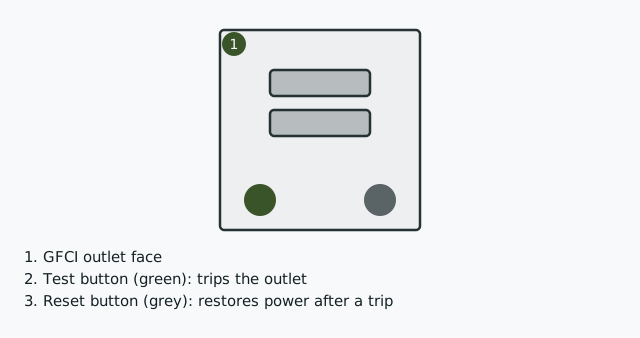
If you are not sure what your home has, press the buttons: a GFCI has a test and a reset button. A breaker-type GFCI has a test button on the breaker. Test them monthly, as Safe Electricity recommends.
Bear in mind that homes with two-prong outlets and no ground need care. A GFCI can be fitted to some ungrounded circuits, marked accordingly, but you must not wire a ground that does not exist. Outlet wiring basics explains the options.
When is the work yours to do and when does California require a contractor?
California law requires electrical work done for others to be carried out by a contractor holding a C-10 electrical license from the Contractors State License Board. The board describes an exemption for owners working on their own property, within limits. Neither removes the code or permit rules, so ask the City of Stockton permit center what your job needs.
Practical rules of thumb:
- Pressing test and reset is for everyone.
- Swapping a GFCI for the same type in the same box is within reach for a careful owner when the power is off and proven dead.
- New circuits, new outlets, outdoor wiring, damaged cable and panel work belong to an electrician.
- A new circuit usually needs a permit and an inspection.
- If a GFCI keeps tripping, stop resetting it and have the circuit checked.
If you are comparing prices for the work, GFCI outlet installation cost shows typical ranges. If you want the job done, a local electrician in Stockton can quote from your description.
Questions people ask
How do I know if an outlet is GFCI protected?
Look for test and reset buttons on the outlet, or a label that reads GFCI protected on a downstream outlet. If neither is there, press the test button on GFCIs in the nearby bathroom, kitchen or garage and see whether the outlet loses power. A plug-in tester shows whether protection works.
Does a GFCI outlet need a ground wire?
A GFCI works without a ground, because it measures the imbalance between hot and neutral, but it should be grounded when the circuit has a ground. On an ungrounded circuit, the device should be marked for that use and you must not add a ground that does not exist.
How often should I test a GFCI?
Safe Electricity advises testing monthly. Press test, check that power goes off, then press reset. If the device does not trip, it is not protecting you and should be replaced. Portable GFCIs should be tested before every use.
Can a GFCI go bad?
Yes. Safe Electricity notes GFCIs are electronic and can be damaged or wear out, and the outlet can keep supplying power even when the GFCI function has failed. If test no longer trips it or reset will not hold, replace it. Stop using it for tools near water until it is fixed.
Is GFCI protection the same as a surge protector?
No. A GFCI protects people from shock. A surge protector limits voltage spikes that harm devices. They solve different problems. If surges are your worry, read about a whole-house surge protector.
Sources used
Last changed