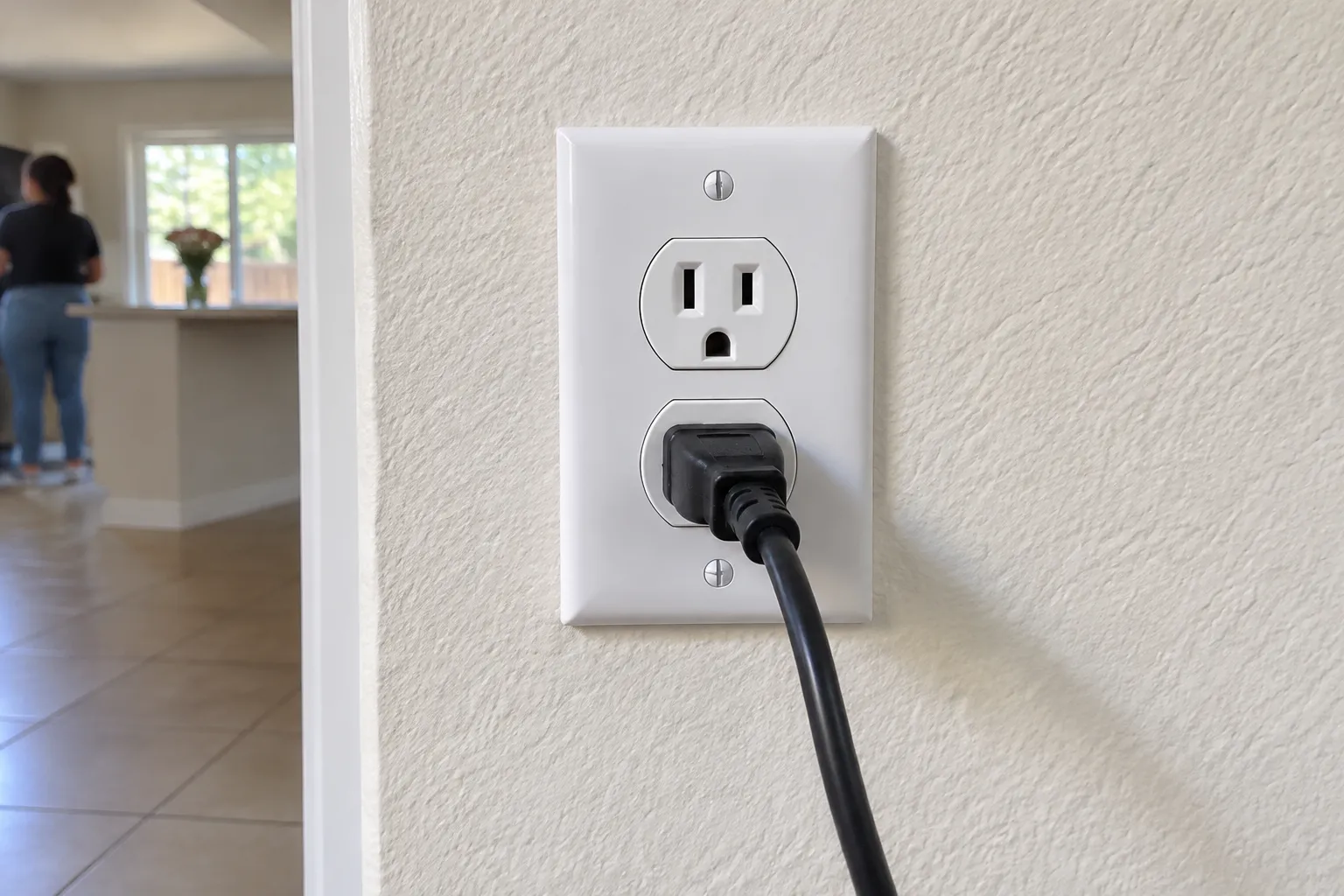
An outlet that has stopped working is most often cut off by a tripped GFCI somewhere else in the house, a tripped breaker, or a loose wire behind the receptacle. Understanding which one you have saves time, because each has a different fix. Start with the quick checks below, which need no tools and no opening of walls. This page is part of the outlets, switches and GFCI guide, and it focuses on diagnosing a dead outlet. If the one you are looking at has a reset button that will not work, go to the page on a reset button that will not reset.
Why would an outlet suddenly have no power?
An outlet that suddenly goes dead has usually lost power upstream: a tripped GFCI, a tripped breaker, or a connection that has worked loose. A power surge or a failed device is less common. Check the panel and any GFCI outlets first, because both are free to check and quick to reset.
Work through the usual suspects in this order:
- A GFCI that protects it. A GFCI in a bathroom, kitchen or garage can control outlets elsewhere. Press reset on each one.
- A tripped breaker. Look for one that sits between on and off, switch it fully off, then on.
- A loose or failed connection. Wires push into the back of many receptacles and can shake loose over the years.
- A worn-out receptacle. The internal contacts wear, and plugs fall out or make a poor connection.
- A switch controlling the outlet. In some rooms a wall switch controls one half of an outlet or the whole thing, so flip it.
Before you do anything else, plug in a lamp or charger you know works. A faulty appliance or a blown fuse in a plug can look just like a dead outlet.
Why would only certain outlets stop working?
If only some outlets are dead, they probably share a circuit, and something on that circuit has stopped feeding them. That could be a tripped GFCI, a tripped breaker or a loose wire at the first outlet in the chain. Map which outlets are dead and the pattern points to the cause.
Walk through the house with a lamp and note which outlets are out. Then think about how they are connected:
- Everything in one room is dead. A breaker or a GFCI is likely.
- One outlet is dead and the others on the wall work. The dead one has a loose wire, a bad receptacle, or a single switched half.
- The dead outlets are in different rooms. That points to a GFCI upstream, often one in a bathroom, garage or outside, which feeds outlets elsewhere.
- Only the top or bottom half is dead. The outlet is probably a switched receptacle or has a broken connecting tab.
The chain matters because most outlets are wired in a run. Power reaches the first one, passes through, and carries on to the next. A loose wire at one point can cut off every outlet after it. That is why one failed connection can take out several outlets and why an electrician starts with the first one in the run.
How do I check a circuit breaker?
Open the panel and find the breaker for the dead outlets. A tripped breaker sits in the middle, or shows a different color flag. Push it fully to off, then back to on. If it holds, the outlet should work. If it trips again, stop and do not keep switching it back on.
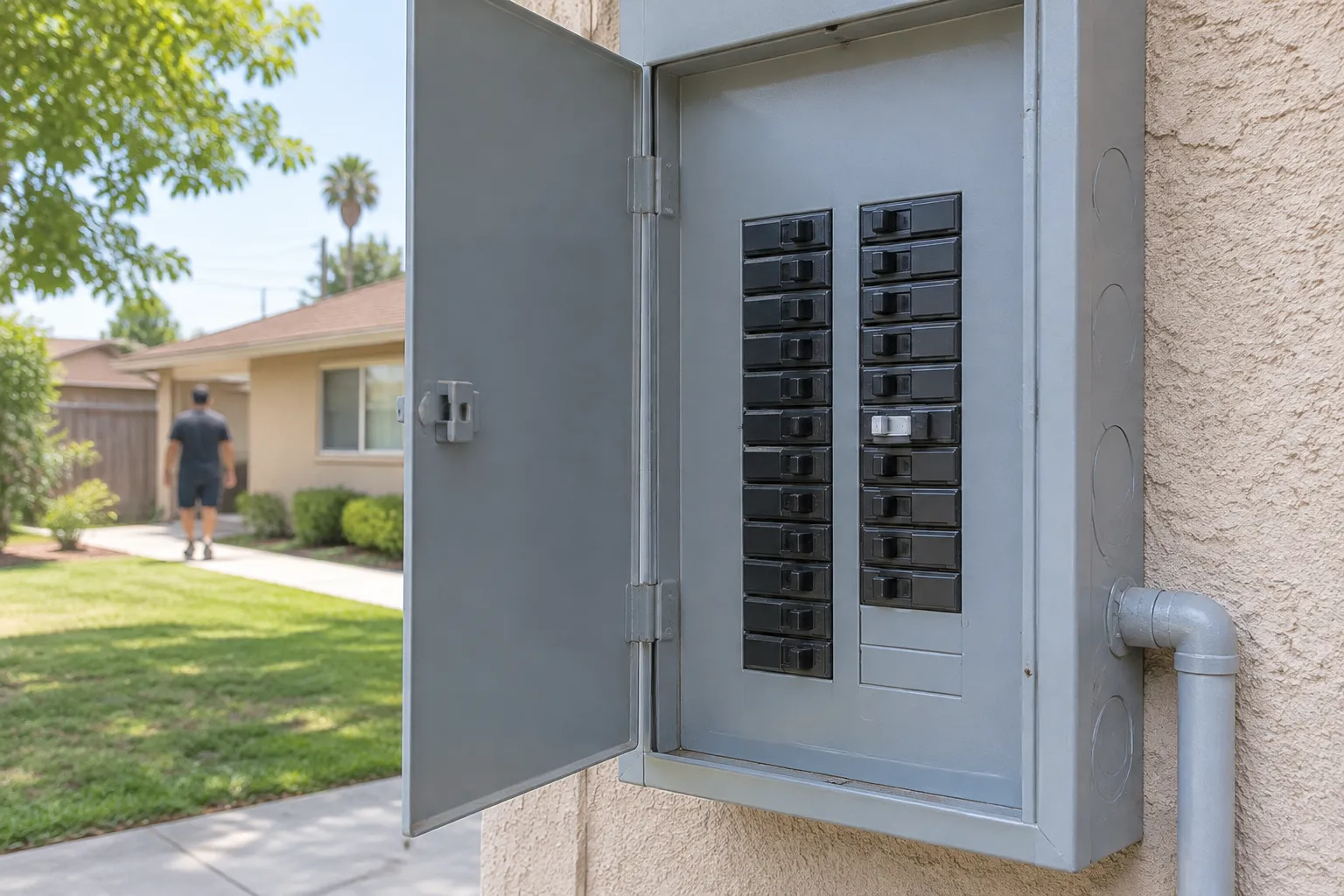
A few safe points about the panel:
- Do not remove the panel cover. Only the door that exposes the breaker switches is meant for you.
- A breaker can trip without looking tripped. If a circuit is dead and the breaker looks fine, switch it off and on once.
- Label the breakers. If your panel is not labeled, turn a radio on in the dead room and switch breakers one at a time. Do this carefully and do not touch the panel's inside.
- A repeated trip is information. An overload, a short or a fault is making it trip. Why a breaker keeps tripping explains the likely causes.
If the panel is older, hot to the touch, buzzing or has scorch marks, stop and call a local electrician. A panel upgrade may be the real answer.
When is a dead outlet a sign of something dangerous?
Treat a dead outlet as urgent if it is hot, smells burnt, has scorch marks, makes a buzzing or crackling noise, or sparks when you plug in. Stop using it, turn off its breaker and call an electrician. If you see smoke or flames, leave and call 911.
Signs that point to a fault that is getting worse:
- Discolored or melted plastic on the cover or the outlet.
- A plug that feels hot after use.
- Lights that dim or flicker when the outlet is used. See flickering lights.
- A breaker that trips every time you plug something in.
- A loose outlet that moves in the wall or does not hold a plug.
Do not tape over a bad outlet or leave it plugged in. The risk is heat at a loose connection, which can start a fire inside a wall where you cannot see it. The fix is to repair the connection, not to live with it.
Can I fix a dead outlet myself?
You can fix some dead outlets yourself. Resetting a GFCI and a breaker are safe for anyone. Replacing a receptacle is work you can do if you are confident, switch the power off at the panel and confirm it is off with a tester. Stop if the wiring looks damaged or does not match what you expect.
California law requires electrical work done for others to be carried out by a contractor holding a C-10 electrical license. The Contractors State License Board describes an exemption for owners working on their own property, within limits, and that exemption does not remove the code or any permit rule. Ask the City of Stockton permit center what your job needs. A like-for-like swap is often treated differently from new wiring.
The outlet electrical wiring basics page explains what you will see behind the plate if you decide to look.
If power has gone out across a wider area, the cause may be outside the house. Electrician for a power outage covers that case.
How much does it cost to fix a dead outlet in Stockton?
National price guides put replacing an existing outlet at about $80 to $350 and a GFCI replacement at about $100 to $300. A service call minimum of $100 to $200 often applies. Finding a hidden wiring fault costs more. Your electrician's quote overrides these national figures.
The GFCI outlet installation cost page covers the breakdown in more detail. If you want to know who can do the job near you, a local electrician in Stockton can quote it after looking at the circuit.
Questions people ask
Can a power surge damage an outlet?
Yes. A strong surge can burn the contacts inside an outlet or damage a GFCI so that it no longer resets. Most surges are small, but a lightning strike or a utility fault can cause real damage. A whole-house surge protector reduces the risk to outlets and the devices plugged into them.
What do you call it when an outlet stops working?
People call it a dead outlet. Electricians describe it as an outlet that has lost power, a failed receptacle, or an open circuit, depending on the cause. The term matters little when you call for a quote. Say which outlets are dead, when it started and whether any GFCI or breaker has tripped.
How often should outlets be replaced?
There is no fixed schedule. Replace an outlet when it is cracked, loose, hot, scorched or no longer holds a plug firmly. Safe Electricity advises replacing a GFCI as soon as it stops working properly. Outlets in heavily used rooms wear faster, and in older homes many are worth updating together.
How can you tell if an outlet is going bad?
Plugs that fall out, a warm outlet, crackling, scorch marks, flickering lights when you use it or a device that works intermittently are all signs. A GFCI that no longer trips when you press test is also failing. Stop using any outlet with heat or burn marks and have it checked.
How much does an electrician usually charge to replace an outlet?
National price guides put a standard outlet replacement at roughly $80 to $350, with a service-call minimum often applying. A GFCI runs about $100 to $300. Extra work such as repairing a damaged wall, a permit or tracing a fault adds to that figure.
Sources used
- Safe Electricity: Ground Fault Circuit Interrupters
- Contractors State License Board: owner-builder overview
- Published 2025 and 2026 online price guides for outlet replacement, checked November 2026
Last changed